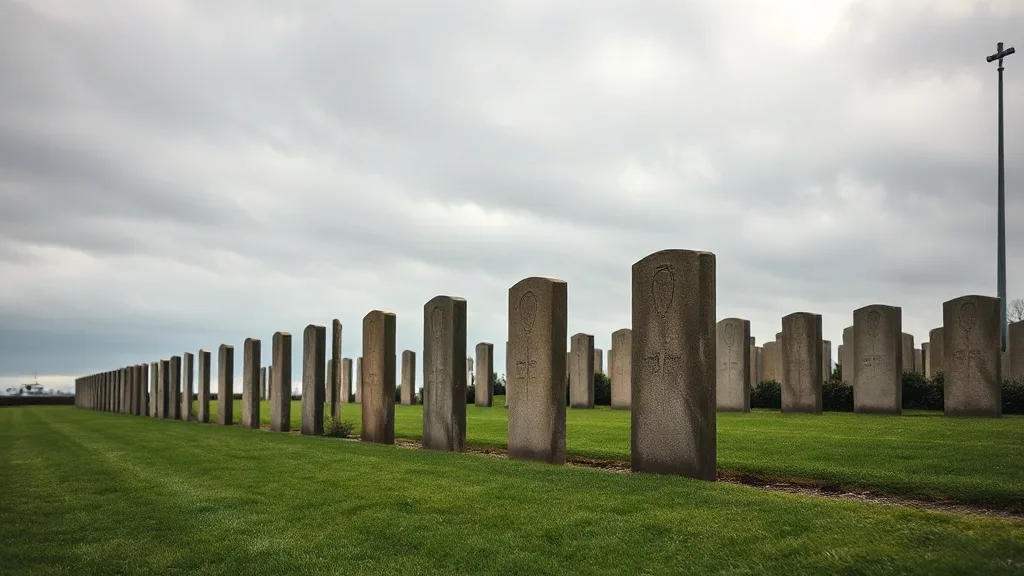
Four airmen killed when their Lancaster bomber came down in Germany in December 1944 have been commemorated under their own names at last, the BBC reports. A rededication service took place at the Commonwealth War Graves Commission's Venray War Cemetery in the Netherlands for Flying Officer Leslie Markland Hough of the Royal Australian Air Force, Pilot Officer John Henry Tales, Sergeant Henry Charles Burnside and Sergeant John Lawson, both of the Royal Air Force Volunteer Reserve. Administrative mistakes made after the war meant their resting place was recorded as unknown for more than eight decades.
Key points
- Service held — at Venray War Cemetery in the Netherlands, led by Reverend (Group Captain) Ruth Hake.
- Aircraft — Lancaster PD374 of No. 218 Squadron RAF, lost on 8 December 1944 during a raid on the Neerbeck oil plant at Homberg.
- Survivors — three of the seven-man crew escaped by parachute and became prisoners of war; the other four died.
- Families present — relatives of the men attended, some learning more about their uncles' service.
Lancaster PD374 left RAF Methwold in Norfolk on the morning of 8 December 1944, one of more than 130 aircraft sent to attack the Neerbeck oil plant at Homberg in the Ruhr. Of the seven men on board, three got out by parachute and were taken prisoner. The remaining four were killed. Witness accounts suggest that the Australian captain, Flying Officer Hough, stayed at the controls of the burning aircraft so that others could get clear.
Pilot Officer Tales was born in Attercliffe, Sheffield, on 31 December 1917, one of eleven children, and worked as a poster writer before joining the RAF in September 1939. He had already finished a full operational tour when he volunteered to return to frontline duties, joining No. 218 Squadron in August 1944. Sergeant Burnside was remembered for his professionalism and smart turnout, while Sergeant Lawson, known to comrades as "Geordie", came from a mining family in County Durham.
Tracey Bowers, a caseworker at the Joint Casualty and Compassionate Centre, said the presence of so many families had made the occasion particularly poignant, and described seeing them with local people who had adopted the graves as incredibly moving. John Tales, a nephew of the pilot officer, said the family felt honoured and overwhelmed, and thanked everyone who had made the day possible. Thurston Lawson, nephew of Sergeant Lawson, called it a fantastic and memorable day. Dr Daniel Seaton of the CWGC said relatives could now visit known graves in perpetuity, and that the commission would keep tending them with care.
What it means in practice
This is a story about records rather than rules, so it changes little in day-to-day life for most people in Britain. Its practical value lies in what it shows about how wartime paperwork went wrong, and how families can still get answers.
- For relatives of wartime servicemen — if a grave or a casualty record looks wrong, the Joint Casualty and Compassionate Centre and the CWGC can review cases, even after many decades.
- For anyone researching family history — service records, squadron histories and eyewitness accounts are the places to look when official paperwork has gaps.
- For cemetery visitors — the graves at Venray are now marked with names, so families and researchers can find them directly.