
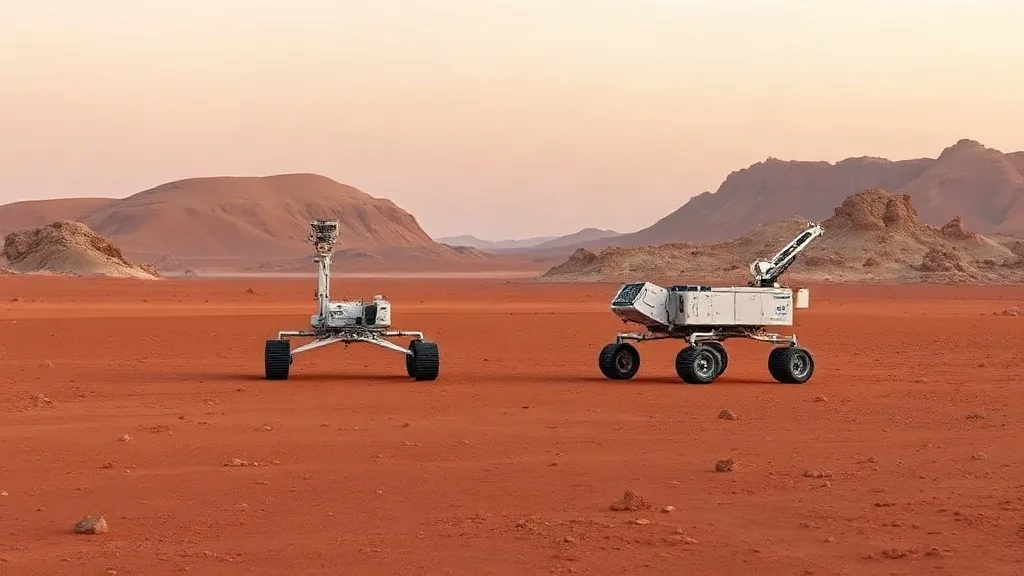
The UK is making a significant contribution to Europe's quest to discover whether life has ever existed on Mars, according to the European Space Agency. Through the ExoMars programme, which consists of two missions, scientists are studying the red planet both from orbit and, in the future, from its surface.
Key points
- Trace Gas Orbiter — circling Mars since 2016, analysing atmospheric gases and relaying more data than all other Mars orbiters combined.
- Rosalind Franklin rover — will drill two metres into the surface to search for evidence of past or present life, landing in the clay-rich Oxia Planum region.
- UK investment — around £490 million over 20 years, supporting over 200 high-skilled jobs and more than 130 UK scientists.
- UK-built rover — assembled by Airbus Defence and Space in Stevenage, with instruments led by University College London and others.
The Trace Gas Orbiter (TGO) has been in orbit since 2016 and began science operations in 2018. It carries four instruments to detect trace gases such as methane, which on Earth is linked to both biological and geological processes. Although TGO has not yet found methane, it has discovered hydrogen chloride and water-ice at low latitudes. The water-ice is particularly important because it could be converted into oxygen, fuel and drinking water for future human explorers.
The Rosalind Franklin rover, named after the British scientist whose work was crucial to understanding DNA, will be the first European rover to traverse Mars. It will drill down to two metres to collect samples protected from surface radiation, and its on-board laboratory will analyse their mineral and chemical composition. The mission will target Oxia Planum, where ancient clay-rich rocks suggest water once existed.
The UK has invested around £490 million over the past 20 years, supporting over 200 high-skilled jobs and involving more than 130 UK scientists. The rover is being built by Airbus Defence and Space at its Stevenage facility. UK-led instruments include the PanCam panoramic camera system, developed by University College London's Mullard Space Science Laboratory with the University of Aberystwyth, Birkbeck College, and the University of Leicester.
What it means in practice
The ExoMars programme demonstrates the UK's ongoing commitment to space science and innovation, with direct consequences for jobs, research funding and international collaboration. While the mission itself may not change daily life for most people, it supports a high-skilled workforce and maintains the UK's position in global space exploration.
- Jobs and skills — the programme sustains over 200 high-skilled roles across the UK, from engineering to data analysis, helping to grow the space sector.
- Scientific leadership — UK scientists and institutions are leading key instruments like PanCam, ensuring British expertise shapes the search for life on Mars.
- Future benefits — discoveries about water-ice and Martian chemistry could inform future human missions and inspire the next generation of researchers.